
ICID 2026 · CONFERENCE REPORT
2026 7th International Conference on Intelligent Design (ICID 2026)
Concludes Successfully in Xi’an
Nine experts from China and abroad map a new design paradigm for the intelligent era as young scholars explore the frontiers of intelligent ecosystems
27 October 2026 · Xi’an, China
From 23 to 25 October 2026, the 30th Annual Academic Conference of the Industrial Design Branch of the Chinese Mechanical Engineering Society and the 2026 7th International Conference on Intelligent Design (ICID 2026) were held in Xi’an, Shaanxi Province, China. Coinciding with the 90th anniversary of the Chinese Mechanical Engineering Society and the 40th anniversary of its Industrial Design Branch, the event was themed “Innovative Design Leading New Quality Productive Forces” and brought together nearly 400 experts, scholars and delegates from more than 110 universities, 17 research institutes and industry enterprises across the country. As a key component of the annual conference, ICID 2026, themed “A New Paradigm for Design in the Intelligent Era”, completed its full program from the afternoon of 24 October to the morning of 25 October and drew to a successful close.

Group photo of delegates at the Shaanxi Hotel
SECTION 01
A New Design Paradigm for the Intelligent Era: Over 90 Delegates Gather in Xi’an
ICID 2026 was guided by the Innovation Design Industry Strategic Alliance of China and supported by the Xi’an Municipal Bureau of Science and Technology and the Industrial Design Branch of the Chinese Mechanical Engineering Society. It was jointly hosted by the Innovation Design Alliance of Silk Road Economic Zone, the Management Committee of Xi’an Beilin University-based Innovation Industrial District, the Xi’an Beilin District Science, Technology and Industry Informationization Bureau, and the Xi’an Design Union, and co-organized by the Xi’an Design Union and the AEIC Academic Exchange Information Center.
The conference was held on the afternoon of 24 October at the Shaanxi Hotel and was co-chaired by Prof. Chunlei Chai of Zhejiang University and Ms. Fanrui Fu, Director of the Office of the Xi’an Design Union. More than 90 delegates from Chinese universities, manufacturing enterprises and design research institutes attended. Focusing on theoretical innovation, technology transfer and the reshaping of the industrial ecosystem in design disciplines amid the rapid iteration of artificial intelligence, the conference was dedicated to building a high-level academic exchange bridge connecting universities, interdisciplinary fields and industry–academia–research collaboration.

The ICID 2026 venue
SECTION 02
Nine Keynote Speeches: A Panorama of Intelligent Design from Large Language Models to Humanoid Robots
Nine keynote speeches were delivered in total: seven leading experts in design and interdisciplinary fields presented on site in Xi’an, while two internationally renowned scholars joined online by video. Drawing on academic strength from universities and research institutes at home and abroad, the programme followed the frontiers of intelligent design throughout, covering AI-empowered design innovation, the intelligent construction of Chinese aesthetics, the exploration of design boundaries in the context of digital–physical integration, human–machine fusion and human-centred intelligent therapy, LLM-driven intelligent design and human factors research, AGI agents and human–machine symbiosis, the user mechanism behind the localised appearance of humanoid robots, and emerging directions such as soft and bio-inspired robotics and the intelligent Internet of Things.
Hao Tan: Intelligent Design and Human Factors Research for Large Language Models
Professor and Doctoral Supervisor, School of Design, Hunan University; Deputy Director, Centre for Culture and Media Computing, Hunan University
The talk focused on the transformations and far-reaching impacts that large language models (LLMs) have brought to intelligent design and human factors research in terms of both research objects and research tools. After systematically reviewing the core characteristics of LLMs, Prof. Tan presented, from the perspective of design objects, the research outcomes on LLM-based interaction design currently being advanced at Hunan University, and offered an in-depth discussion and forward-looking analysis of future directions and emerging trends in the field.

Prof. Hao Tan delivering his keynote speech
Jingyan Qin: The Endless Frontier Beyond the Boundaries of Intelligent Design under the Mandate of a Digital–Physical Ecological Civilisation
Professor and Doctoral Supervisor, Vice Dean of the School of Intelligence Science and Technology, University of Science and Technology Beijing
Centring on the ten core missions of artificial intelligence and innovative design in the context of a digital–intelligent ecological civilization, Prof. Qin proposed the SSPSS meta-design method for intelligent sustainable product–service ecosystems, guided by the dimensions of product, content, system and life, together with the CMR+FBS design ontology framework. The approach advances the construction of a tripartite design system that deeply integrates nature, the digital and the humanities, offering new thinking with both theoretical depth and practical guidance for co-building a harmonious natural–digital ecological civilization, and pointing to promising directions for pushing beyond the existing boundaries of intelligent design.

Prof. Jingyan Qin delivering her keynote speech
Lingyun Sun: Constructing Chinese Aesthetics in the Age of Artificial Intelligence
Professor, Vice Dean of the College of Artificial Intelligence and Dean of the International Design Institute, Zhejiang University
Taking “let each beauty be appreciated and all beauties flourish together” as its thread, the talk started from the aesthetic transformation brought about by artificial intelligence and explored how Chinese aesthetics can move beyond the surface expressions of traditional symbols and visual styles. Instead, it seeks contemporary expressions in classical Chinese aesthetic concepts such as lingering artistic conception, the aesthetics of blank space, rhythmic vitality, learning from nature, harmony and coexistence, and endless renewal, extending further into intelligent products, digital content, human–computer interaction and intelligent living, thereby opening new ways to integrate AI with traditional aesthetics.
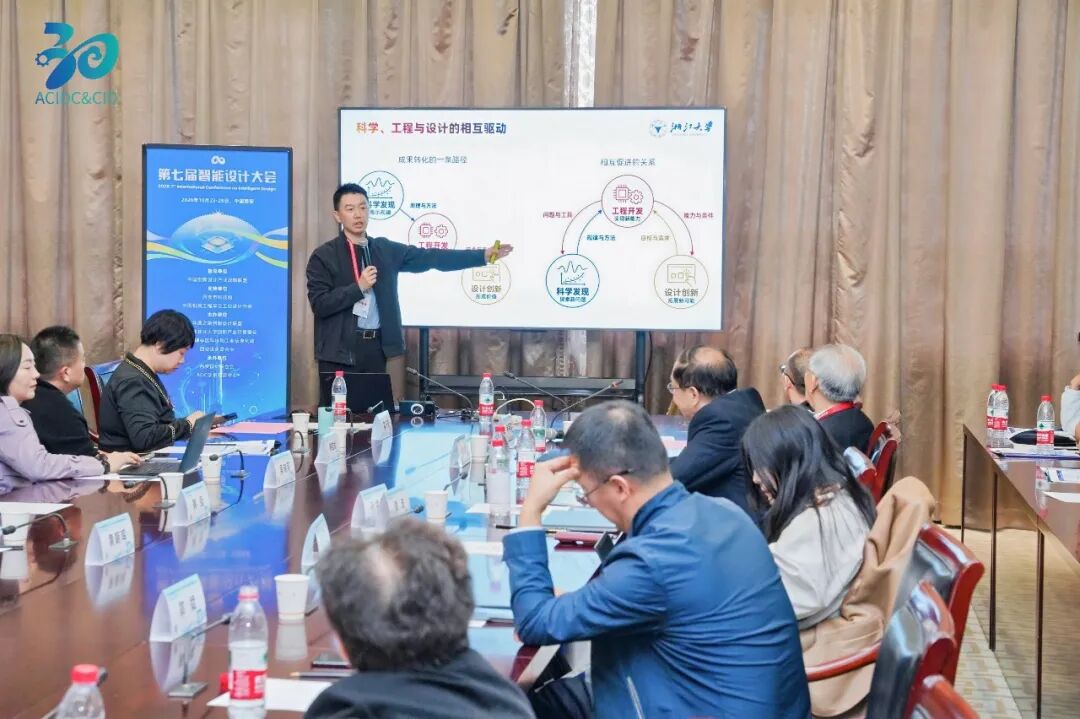
Prof. Lingyun Sun delivering his keynote speech
Bin Guo: AGI Agents and Future Human–Machine Symbiosis
Professor and Vice Dean of the School of Computer Science, Northwestern Polytechnical University
The talk examined the future evolutionary path of artificial general intelligence and the scientific challenges it faces. Prof. Guo introduced new research trends in AGI agents from the perspectives of role shaping, mental models and large-scale social simulation, shared the emerging interdisciplinary technologies and research practices required to build a future human–machine symbiotic ecosystem, and released his team’s latest research results.

Prof. Bin Guo delivering his keynote speech
Xiaoli Wu: Design Specifications for Human–Machine–Object Elements and Virtual–Real Scenarios in Industrial Digital Twin Systems
Professor, School of Design, Art and Media, Nanjing University of Science and Technology
Focusing on key links such as the classification and coding of all human, machine and object elements, modelling, data interaction, virtual–real synchronisation, system integration and verification assessment, Prof. Wu systematically elaborated the latest specifications for the design of industrial digital twin systems, providing a standardised basis for human–machine fusion and intelligent interaction design in smart workshops.

Prof. Xiaoli Wu delivering her keynote speech
Ting Han: Key Technologies, System Development and Innovative Applications of Human-Centred Intelligent Therapy Based on AI+HI Fusion Intelligence
Professor and Dean of the USC–SJTU Institute of Cultural and Creative Industry, Shanghai Jiao Tong University
Addressing the imbalance between technological rationality and humanistic care in the intelligent transformation of healthcare, Prof. Han proposed a theoretical framework that reconciles intelligent efficiency with human-centred values, introduced the key technologies and system solutions, and presented related innovative application demonstrations, offering a systematic practical path for future healthcare innovation.

Prof. Ting Han delivering his keynote speech
Zhaohui Huang: The Head–Body Asymmetry Effect in the Anthropomorphic Appearance of Humanoid Robots
Professor and Director of the Industrial Design Innovation Centre, Huazhong University of Science and Technology
Prof. Huang proposed a differentiated styling strategy of “restraint in the head, assertiveness in the body” together with principles for allocating visual hierarchy resources. Design translation and prototype verification were completed in industrial human–machine collaboration scenarios, providing an actionable practical path for the appearance iteration of locally developed humanoid robots under the intelligent design paradigm.

Prof. Zhaohui Huang delivering his keynote speech
ONLINE
Online Speeches (2): Two International Scholars Join Remotely
Owing to international travel and on-site arrangements, two internationally renowned scholars were unable to travel to Xi’an and delivered their speeches by video. The conference expresses its sincere gratitude to them for their support across time zones: their participation allowed ICID 2026 to retain its international perspective and academic diversity beyond the on-site programme.
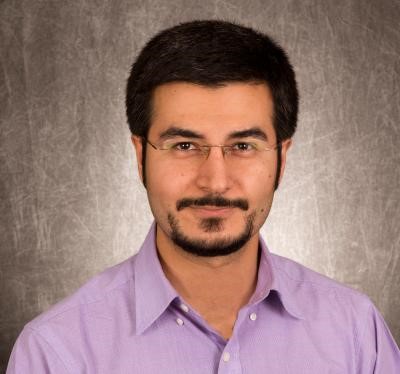
Hamid Marvi
ONLINE SPEECH
Associate Professor of Mechanical and Aerospace Engineering, Arizona State University, USA; Director, Bio-Inspired Robotics, Technology and Healthcare (BIRTH) Laboratory; Senior Member, National Academy of Inventors; Senior Member, IEEE
The talk centred on soft and bio-inspired robots, magnetically actuated robotic systems and minimally invasive medical robotics. It discussed how bio-inspired structures and magnetic actuation can improve the reachability and safety of robots within narrow, compliant anatomical passages, and outlined pathways towards clinical translation in interventional diagnosis and treatment.
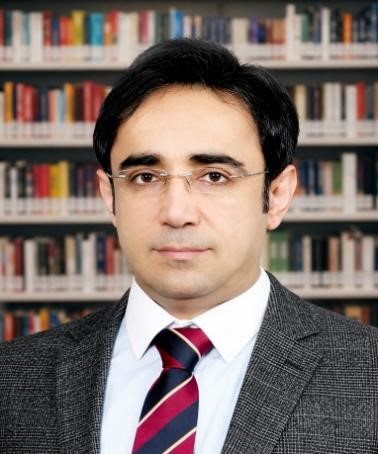
Md. Jalil Piran
ONLINE SPEECH
Associate Professor, Department of Computer Science and Engineering, Sejong University, Republic of Korea; Vice Chair, Technical Committee on Machine Learning, Deep Learning and Consumer Electronics AI, IEEE Consumer Technology Society; Senior Member, IEEE; Editor, IEEE Transactions on Intelligent Transportation Systems
The talk focused on the convergence of artificial intelligence and machine learning methods, big data analytics, and the Internet of Things with next-generation communication systems. It analysed the challenges facing data-driven intelligent systems in communication resource scheduling, edge intelligence deployment, and security and privacy protection, and introduced corresponding technical approaches and representative application scenarios.
SECTION 03
Young Scholars’ Intelligent Design Forum: Thirteen Early-Career Researchers Present
On the morning of 25 October, the Young Scholars’ Intelligent Design Forum — the oral presentation session of ICID 2026 — was held alongside the “Design Trends: Industry–University Joint Release” and the “Industry–Academia Roundtable Dialogue”. Centred on the theme of intelligent ecosystems, the forum was moderated by Yao Wang and Mingxin Yang of Northwestern Polytechnical University.
Thirteen young scholars from Beijing University of Chemical Technology, Beijing Institute of Technology (Zhuhai), Xi’an Technological University, Guizhou University, Xi’an Jiaotong University, Shandong Jianzhu University, Lanzhou University of Technology, Northwest A&F University and other institutions presented their latest research ideas and interim results, spanning intelligent algorithm iteration, visualization and simulation technology, multimodal perception analysis, parametric implementation, and knowledge-driven creative generation. Topics ranged from the design of campus shared-bicycle dispatching and transport equipment, the “familiarity paradox” of campus wayfinding signage, and a web-based 3D real-time visualization method for impact-resistant design of multi-storey buildings, to multimodal quantitative assessment of chronic trapezius injuries, electromagnetically assisted lubrication design for marine shafting thrust bearings, crane girder stress prediction based on hierarchical Kriging, multimodal-stimulus knowledge-driven intelligent design, and the parametric realization of integrated design and production for metal panel custom furniture.
Each presenter was allocated 15 minutes including presentation and discussion, and authors participating in oral or poster presentations received presentation certificates.

The Young Scholars’ Intelligent Design Forum (ICID 2026 oral presentations)

Presenters of the Young Scholars’ Intelligent Design Forum receiving their presentation certificates
Six Young Scholars’ Forums were held in parallel during the annual conference, covering intelligent design, design methods and product innovation, health-and-well-being ergonomics and human–computer interaction, intelligent cockpits and engineering machinery, aviation and engineering equipment innovation, and cultural heritage and furniture innovation design. Balancing theoretical exploration with applied contexts, the forums provided a high-level platform for academic sharing, intellectual exchange and interdisciplinary innovation among early-career researchers.
SECTION 04
Closing Session: The Fundamental Mission of Design Is to Serve Industrial Modernization
At the closing session, Prof. Changde Lu, Conference Chair, Professor of Northwestern Polytechnical University and Director of the Institute of Industrial Design, presented moderator certificates to Prof. Chunlei Chai of Zhejiang University and Ms. Fanrui Fu, Director of the Office of the Xi’an Design Union, and presented certificates to all keynote speakers.

Conference Chair Prof. Changde Lu presenting moderator certificates to Prof. Chunlei Chai and Ms. Fanrui Fu
In his closing remarks, Prof. Lu noted that the development of human civilisation has always involved a contest between truth, goodness and beauty on one side and falsehood, ugliness and evil on the other, with the dominant methodology determining its direction. Artificial intelligence has now become the new arena of this contest: technology itself carries no moral attribute, and it is the control over it and the parties it serves that define its value. Only by developing intelligent technologies with a community with a shared future for mankind in mind can they truly benefit all of humanity. He observed that space exploration, lunar development and artificial intelligence are now widely recognised as the three core tracks globally, and that seizing the initiative in artificial intelligence means seizing the opportunities of the era. The fundamental mission of design in all its forms is to serve industrial modernisation and empower advanced manufacturing — a “new long march” for designers, in which intelligent innovation is the crucial tool for overcoming difficulties. Technology is the key support in competition, but long-term development ultimately rests on people, and the ultimate test of design is the recognition of the people and a precise fit with the real needs of industry.

Prof. Changde Lu delivering the closing summary
SECTION 05
The Annual Conference at a Glance: Nearly 400 Delegates on “Innovative Design Leading New Quality Productive Forces”
The 30th Annual Academic Conference of the Industrial Design Branch of the Chinese Mechanical Engineering Society was hosted by the Chinese Mechanical Engineering Society and Northwestern Polytechnical University, and organized by the Industrial Design Branch of the Chinese Mechanical Engineering Society, the School of Mechanical Engineering of Northwestern Polytechnical University and other units. On the morning of 24 October, the opening ceremony was held at the Shaanxi Hotel and chaired by Prof. Shouqian Sun, Vice Chair of the Industrial Design Branch of the Chinese Mechanical Engineering Society. Mr. Chenglin Yang, Deputy Director of the Department of Industry and Information Technology of Shaanxi Province; Prof. Kaifu Zhang, Vice President of Northwestern Polytechnical University; and Prof. Ming Mao, Academician of the Chinese Academy of Sciences and Vice President of the Chinese Mechanical Engineering Society, attended and delivered speeches.

The 30th Annual Academic Conference of the Industrial Design Branch of the Chinese Mechanical Engineering Society and ICID 2026
The opening ceremony featured a roundtable forum commemorating the 40th anniversary of the Industrial Design Branch under the theme “Passing the Torch, Designing the Future”. Prof. Changde Lu of Northwestern Polytechnical University, Prof. Hanqing Chen of Wuhan University of Technology, Prof. Shouqian Sun of Zhejiang University, Prof. Jian Zhang of Shenyang University of Technology and Prof. Chunlei Chai of Zhejiang University took part in the discussion, which was moderated by Prof. Guoqiang Chen, Vice President of Yanshan University. The experts reviewed four decades of the Branch’s development and discussed discipline building, design education and future directions.

The roundtable forum commemorating the 40th anniversary of the Industrial Design Branch
In the keynote session of the annual conference, Academician Ming Mao, Prof. Peihua Gu, Director Bin Tian, Prof. Tie Ji and Chief Engineer Jun Feng delivered reports on, respectively, a new paradigm for equipment manufacturing in a digital-industry society, adaptive engineering design theories and methods in the AI era, industrial design empowering new industrialisation, future terminals and service design through human–AI co-creation, and human factors ergonomics design for intelligent cockpits of aviation equipment. The conference also featured eight parallel sub-forums with 56 experts, scholars and industry representatives; three thematic workshops on innovation design and human factors engineering, artificial intelligence and brain–computer design, and brand thinking and cross-cultural design; and six Young Scholars’ Forums. A release of intelligent design trends was held concurrently. The conference closed on 25 October after completing all agenda items, with the closing ceremony chaired by Prof. Dengkai Chen, Director of the Key Laboratory of Industrial Design and Ergonomics of the Ministry of Industry and Information Technology, Northwestern Polytechnical University.
OPENING REMARKS AND KEYNOTES AT THE ANNUAL CONFERENCE

Chenglin Yang, Deputy Director, Shaanxi Provincial Department of Industry and Information Technology

Kaifu Zhang, Vice President, Northwestern Polytechnical University

Ming Mao, Academician of the Chinese Academy of Sciences

Ming Mao: A New Paradigm for Equipment Manufacturing in a Digital-Industry Society

Peihua Gu: Adaptive Engineering Design Theories and Methods in the AI Era

Bin Tian: Industrial Design Empowering New Industrialisation

Tie Ji: Future Terminals and Service Design through Human-AI Co-creation

Jun Feng: Human Factors Ergonomics Design for Intelligent Cockpits of Aviation Equipment
SECTION 06
About AiScholar
AiScholar (艾思科蓝) positions itself as a connector in the research field, exploring the deep integration of “artificial intelligence + research and academia” and building a new AI for Science service paradigm. It provides full-process digital and intelligent solutions and professional services in academic exchange, research publishing, institutional research capacity building and technology transfer, driving the digital transformation of the research service industry. The platform offers one-stop digital and intelligent research services to researchers and institutions worldwide, connecting high-quality academic resources from universities, research institutes and academic organizations, and enabling the output, dissemination and transfer of innovative research outcomes.
As one of the supporters of ICID 2026, the AEIC Academic Exchange Information Center and AiScholar provided full-process digital conference services and online submission system support for the event, ensuring smooth coordination of paper solicitation, peer review, registration and on-site logistics.
Programme, publication and indexing updates for ICID 2026 are available on the official conference website,www.ic-id.org.
If you need any help, please feel free and contact:
